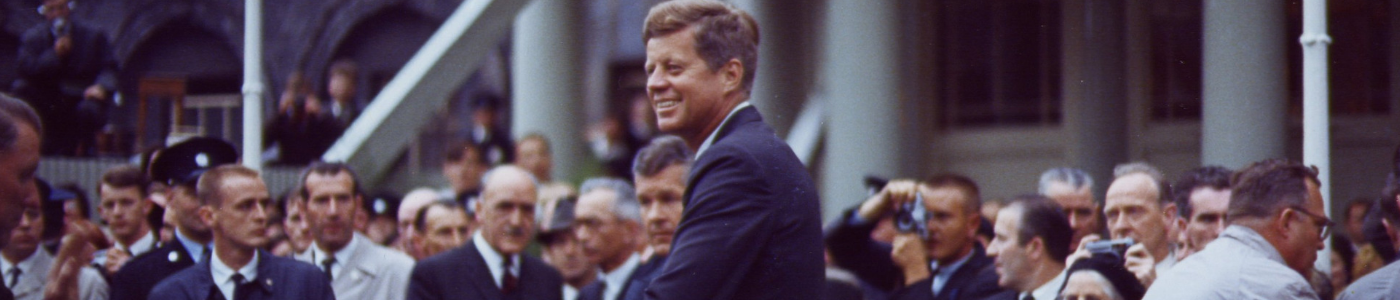
Heroes of History:
John F Kennedy Legacy
John Fitzgerald Kennedy (May 29, 1917 – November 22, 1963), often referred to by his initials as JFK, was an American politician who served as the 35th president of the United States from 1961 until his assassination near the end of his third year in office. Kennedy was the youngest person to assume the presidency by election. He was also the youngest president at the end of his tenure, and his lifespan was the shortest of any president.[2] Kennedy served at the height of the Cold War, and the majority of his work as president concerned relations with the Soviet Union and Cuba. A Democrat, he represented Massachusetts in both houses of the U.S. Congress prior to his presidency.


John F. Kennedy warns of Invisible Government
“The very word “secrecy” is repugnant in a free and open society; and we are as a people inherently and historically opposed to secret societies, to secret oaths and to secret proceedings… Our way of life is under attack. Those who make themselves our enemy are advancing around the globe… no war ever posed a greater threat to our security. If you are awaiting a finding of “clear and present danger,” then I can only say that the danger has never been more clear and its presence has never been more imminent…
For we are opposed around the world by a monolithic and ruthless conspiracy that relies primarily on covert means for expanding its sphere of influence–on infiltration instead of invasion, on subversion instead of elections, on intimidation instead of free choice, on guerrillas by night instead of armies by day. It is a system which has conscripted vast human and material resources into the building of a tightly knit, highly efficient machine that combines military, diplomatic, intelligence, economic, scientific and political operations. Its preparations are concealed, not published. Its mistakes are buried, not headlined. Its dissenters are silenced, not praised. No expenditure is questioned, no rumor is printed, no secret is revealed.”— John F Kennedy, 35th President of the United States, from a speech delivered to the American Newspaper Publishers Association on April 27, 1961.
World War II and a Future in Politics

Soon after graduating, both Joe and Jack joined the Navy. Joe was a flyer and sent to Europe, while Jack was made Lieutenant (Lt.) and assigned to the South Pacific as commander of a patrol torpedo boat, the PT-109.
Lt. Kennedy had a crew of twelve men whose mission was to stop Japanese ships from delivering supplies to their soldiers. On the night of August 2, 1943, Lt. Kennedy’s crew patrolled the waters looking for enemy ships to sink. A Japanese destroyer suddenly became visible. But it was traveling at full speed and headed straight at them. Holding the wheel, Lt. Kennedy tried to swerve out of the way, but to no avail. The much larger Japanese warship rammed the PT-109, splitting it in half and killing two of Lt. Kennedy’s men. The others managed to jump off as their boat went up in flames. Lt. Kennedy was slammed hard against the cockpit, once again injuring his weak back. Patrick McMahon, one of his crew members, had horrible burns on his face and hands and was ready to give up. In the darkness, Lt. Kennedy managed to find McMahon and haul him back to where the other survivors were clinging to a piece of the boat that was still afloat. At sunrise, Lt. Kennedy led his men toward a small island several miles away. Despite his own injuries, Lt. Kennedy was able to tow Patrick McMahon ashore, a strap from McMahon’s life jacket clenched between his teeth. Six days later two native islanders found them and went for help, delivering a message Jack had carved into a piece of coconut shell. The next day, the PT-109 crew was rescued. Jack’s brother Joe was not so lucky. He died a year later when his plane blew up during a dangerous mission in Europe.
When he returned home, Jack was awarded the Navy and Marine Corps Medal for his leadership and courage. With the war finally coming to an end, it was time to choose the kind of work he wanted to do. Jack had considered becoming a teacher or a writer, but with Joe’s tragic death suddenly everything changed. After serious discussions with Jack about his future, Joseph Kennedy convinced him that he should run for Congress in Massachusetts’ eleventh congressional district, where he won in 1946. This was the beginning of Jack’s political career. As the years went on, John F. Kennedy, a Democrat, served three terms (six years) in the House of Representatives, and in 1952 he was elected to the US Senate.
Soon after being elected senator, John F. Kennedy, at 36 years of age, married 24 year-old Jacqueline Bouvier, a writer with the Washington Times-Herald. Unfortunately, early on in their marriage, Senator Kennedy’s back started to hurt again and he had two serious operations. While recovering from surgery, he wrote a book about several US Senators who had risked their careers to fight for the things in which they believed. The book, called Profiles in Courage, was awarded the Pulitzer Prize for biography in 1957. That same year, the Kennedys’ first child, Caroline, was born.
John F. Kennedy was becoming a popular politician. In 1956 he was almost picked to run for vice president. Kennedy nonetheless decided that he would run for president in the next election.
He began working very long hours and traveling all around the United States on weekends. On July 13, 1960 the Democratic party nominated him as its candidate for president. Kennedy asked Lyndon B. Johnson, a senator from Texas, to run with him as vice president. In the general election on November 8, 1960, Kennedy defeated the Republican Vice President Richard M. Nixon in a very close race. At the age of 43, Kennedy was the youngest man elected president and the first Catholic. Before his inauguration, his second child, John Jr., was born. His father liked to call him John-John.
John F. Kennedy Becomes The 35th President of the United States

John F. Kennedy was sworn in as the 35th president on January 20, 1961. In his inaugural speech he spoke of the need for all Americans to be active citizens. “Ask not what your country can do for you, ask what you can do for your country,” he said. He also asked the nations of the world to join together to fight what he called the “common enemies of man: tyranny, poverty, disease, and war itself.” President Kennedy, together with his wife and two children, brought a new, youthful spirit to the White House. The Kennedys believed that the White House should be a place to celebrate American history, culture, and achievement. They invited artists, writers, scientists, poets, musicians, actors, and athletes to visit them. Jacqueline Kennedy also shared her husband’s interest in American history. Gathering some of the finest art and furniture the United States had produced, she restored all the rooms in the White House to make it a place that truly reflected America’s history and artistic creativity. Everyone was impressed and appreciated her hard work.
The Legacy of John F. Kennedy
President Kennedy’s death caused enormous sadness and grief among all Americans. Most people still remember exactly where they were and what they were doing when they heard the news. Hundreds of thousands of people gathered in Washington for the President’s funeral, and millions throughout the world watched it on television.
As the years have gone by and other presidents have written their chapters in history, John Kennedy’s brief time in office stands out in people’s memories for his leadership, personality, and accomplishments. Many respect his coolness when faced with difficult decisions–like what to do about Soviet missiles in Cuba in 1962. Others admire his ability to inspire people with his eloquent speeches. Still others think his compassion and his willingness to fight for new government programs to help the poor, the elderly and the ill were most important. Like all leaders, John Kennedy made mistakes, but he was always optimistic about the future.
He believed that people could solve their common problems if they put their country’s interests first and worked together.
More about John F. Kennedy
https://www.jfklibrary.org/learn/about-jfk/life-of-john-f-kennedy
May 29, 1917 John F Kennedy
“I look forward to a future in which our country will match its military strength with our moral restraint, its wealth with our wisdom, its power with our purpose.”… President John F. Kennedy
YouTube (https://youtu.be/nc51usFzHBk)
JFK’s 1961 Speech Feels Like A Prophecy For 2022 | President John F. Kennedy
This is an excerpt of President John F. Kennedy’s inaugural address from 1961. We must all listen carefully and with our hearts to understand
Leave a Reply